On Raleigh Water, a softener is rarely needed: the City's 2025 water quality report puts total hardness at about 25 ppm, which is soft. Homeowners who want treatment usually want to change the taste or reduce chloramine, and that calls for filtration. Call the number on this page to be connected with a local plumber in Raleigh who can install a filter or, on hard well water, a softener.
The numbers from Raleigh Water
Raleigh treats water from Falls Lake and Lake Benson, and the 2025 report lists average total hardness of 25.2 ppm as calcium carbonate, with samples ranging from about 22 to 35 ppm. Water in that range is classed as soft. Softeners exist to strip calcium and magnesium out of hard water before they build scale in water heaters, on faucets and on shower glass. With so little of either in city water, a softener has very little to remove.
If someone recommends a softener for a home on city water, ask what problem it would solve, and ask for a hardness test of your own tap rather than a regional claim.
Why people still look into water treatment
Taste and odor are the usual reasons. Raleigh disinfects with chloramine for most of the year (the 2025 average was 2.80 ppm) and switches to chlorine alone for roughly six weeks each spring. During that changeover, many customers notice a stronger pool-like smell, and hydrant flushing can briefly discolor the water.
| What you notice | Equipment that addresses it |
|---|---|
| Chlorine taste in spring, chloramine taste the rest of the year | Activated carbon or catalytic carbon filtration; chloramine needs a filter rated to remove it |
| Grit or particles after nearby flushing or line work | Sediment cartridge on the main line |
| Wanting a dedicated drinking water tap | Under-sink filter or reverse osmosis |
| White crust and scale on a private well | Water softener, after a hardness test confirms it |
Where a softener can earn its keep
Homes outside the Raleigh Water service area in unincorporated Wake County often draw from private wells, and groundwater can differ a lot from treated lake water. Wake County urges well owners to test their water. If results show real hardness, a softener can reduce scale in the water heater and plumbing. Salt-based units add some sodium; for reference, city water already carries about 24 ppm, so people watching sodium may want one tap left unsoftened.
Installation basics
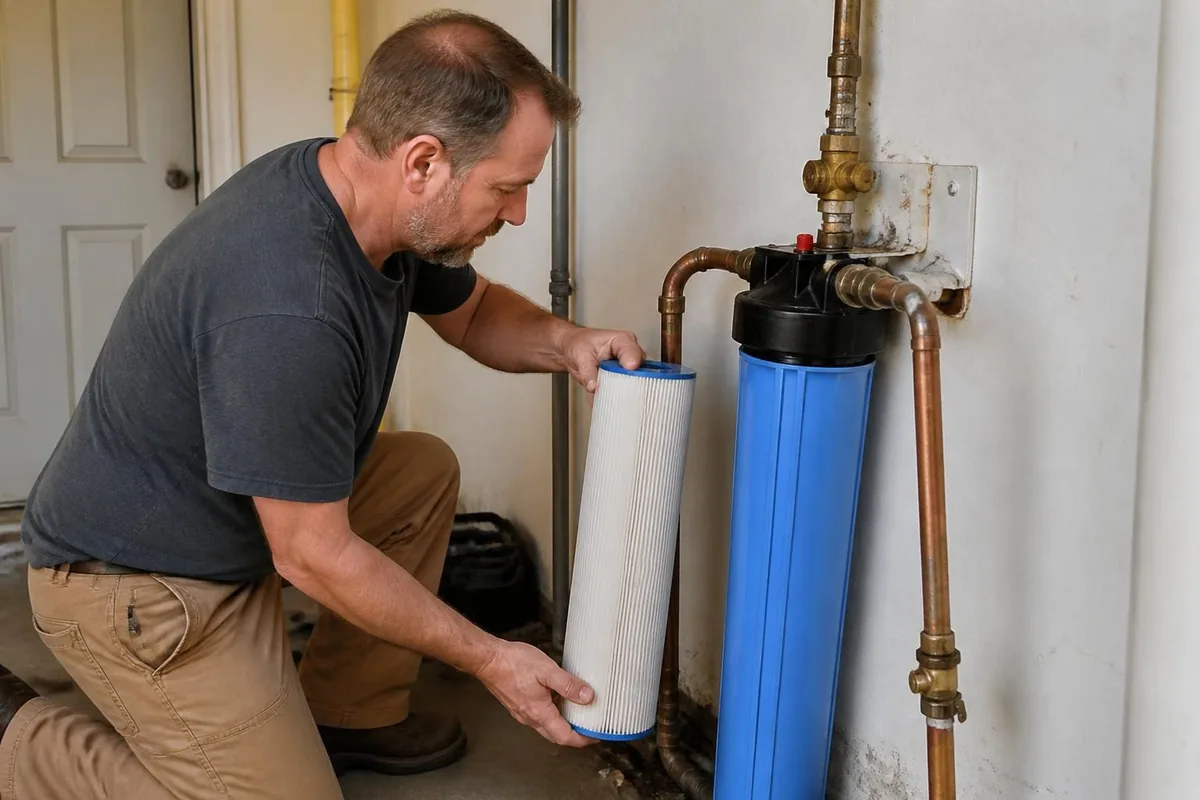
Whole-house filters and softeners go on the main line just past the shutoff, ideally with a bypass so the unit can be serviced without shutting off the house. A softener also needs a drain for its regeneration cycle and, for most models, a nearby outlet. Garages and utility rooms are common spots in Raleigh's newer homes.
What drives the price
Expect cost to vary with the kind of system, its capacity, whole-house versus single-tap setups, how reachable the main line is, and whether a drain and power are close by. Replacement cartridges, membranes and salt add ongoing cost.
Water Softener questions from Raleigh homeowners
Is Raleigh water hard?
Why does my water smell stronger in the spring?
Does a softener take out chloramine?
Should I test my well before buying a softener?
Related plumbing services in Raleigh
Helpful guides
Water Softeners & Filtration in nearby cities and towns
Wake County
Johnston County
Harnett County
Lee County
Nash County
Wilson County
Wayne County
Sources
Last updated: